

“The body listens carefully to the stories the mind keeps repeating.”
Doctor, I Don’t Trust You
There is perhaps no relationship in modern India more paradoxical than the one between patients and doctors.
People enter hospitals with folded hands and simmering suspicions. They distrust the doctor, distrust the hospital, distrust the pharmaceutical industry, distrust “modern medicine,” distrust antibiotics, distrust stents, distrust vaccines, distrust billing systems—and then proceed to ask, often urgently, “Doctor saab, what should we do now?”
Medicine has always depended partly on chemistry and partly on faith. Penicillin kills bacteria, but reassurance lowers cortisol. A surgeon repairs anatomy, but trust calms physiology. The body, unfortunately for sceptics, listens more to patient’s fears than to external chemical molecules. Today, the trust has become so endangered that some patients suspect even reassurance. “Don’t worry” is interpreted as evidence that worrying is urgently require
The Biology of Distrust – The “Nocebo” Effect
Roald Dahl once wrote, “If a person has ugly thoughts, it begins to show on the face.” Neuroscience has now shown that chronic suspicion, fear, and negative expectation often begin to show in body physiology.
Gossip-mill idle chatter such as “Doctors are greedy,” “Doctors take cuts from laboratories,” “Big pharma bribes doctors to prescribe medicine,” “Modern medicine is harmful,” are some of the thoughts bouncing in a patient’s mind as he enters the hospital. This toxic internal environment robs him of nearly 50% benefits that could accrue from faith.
When a patient views medicine as a “poison” or a “scam,” his/her nervous system follows suit. This is the “nocebo effect”—the “evil twin” of the ‘placebo effect’—where negative expectations actually worsen physical health. The research shows that the nocebo effect is a powerful neurobiological phenomenon.[1]
- There is Neurochemical Sabotage: When a patient is suspicious of a doctor’s motives, his/her brain may trigger the release of cholecystokinin, a peptide that facilitates pain transmission and heightens anxiety. Essentially, by expecting the medicine to be a “poison” or a “scam,” the patient’s nervous system begins to treat it as such.[2]
- Negative emotions make the patient pay a Physiological Tax: A study in Psychosomatic Medicine found that patients with “high cynical distrust” had significantly higher levels of inflammatory markers.[3] When a patient enters a consultation in a state of high suspicion, they trigger a “fight or flight” response. Cortisol levels spike, the immune system takes a back seat, and the body becomes less receptive to the actual therapeutic benefits of the treatment.
- The Power of Suggestion works against the patients: Scientific studies have shown that merely warning patients about side effects can make those side effects more likely to occur. In placebo-controlled trials, patients taking inert pills often report headaches, nausea, dizziness, fatigue, and pain simply because they expect them. Asthmatic patients inhaling harmless water vapour after being told it contained an irritant; developed wheezing, and some experienced full asthma attacks. The lungs, apparently, are also susceptible to pessimism.[4]
Where placebo means improvement due to positive expectations, nocebo signifies worsening due to negative expectations. The Latin roots of these terms are wonderfully dramatic: placebo means “I shall please,” while nocebo means “I shall harm.” The astonishing fact is that the harm may occur even when the treatment itself is harmless.
The Three Self-Sabotaging Suspicions
Three types of suspicions lead to self-sabotaging one’s own healing process
- The Hidden Motive: This is the suspicion that the doctor is recommending a procedure not for the patient’s health, but to hit a monthly quota or fund a weekend getaway. While healthy scepticism is a virtue, chronic suspicion shifts the patient’s focus from “How do I get well?” to “How am I being cheated?”
- The Efficacy Enigma: This involves a deep-seated doubt regarding modern medicine itself. The quintessential patient believes that a “natural” herb (which has no standardized dosage) is inherently superior to a “synthetic” drug (which has been through decades of clinical trials). ‘The Liver Doctor’ has made this aspect the subject of his lifetime crusade.[5]
- The Paradox of Presence: Perhaps the most sarcastic irony of all is the patient who spends an hour explaining why doctors are untrustworthy, yet remains seated in the exam room. It is the medical equivalent of visiting a chef you believe is a poisoner and then asking for a second helping of the soup.[6]
The human brain is not an objective observer. It is an overenthusiastic intern constantly trying to identify danger. Evolution rewarded those who overreacted to threats. The caveman who ignored rustling bushes became dinner. The anxious caveman survived to produce anxious descendants—namely, us. Unfortunately, modern humans now apply prehistoric threat detection to laboratory reports. They will worry incessantly even if one of 100 odd lab reports is marginally beyond range.
Negative expectations activate anxiety pathways. Anxiety alters autonomic tone, increases sympathetic activity, heightens pain perception, amplifies bodily sensations, worsens insomnia, and increases vigilance toward symptoms. [7]
The Side-Effect Olympics
Pharmaceutical leaflets are masterpieces of legal paranoia. To avoid lawsuits, they list every symptom ever reported within a 200-kilometer radius of the drug trial. After reading them, even distilled water appears hazardous.
After reading the leaflets, some patients enter a remarkable psychological state in which every bodily sensation becomes attributable to the medicine. A patient starts ‘statin’ and two days later, his eyebrows feel heavy, and his legs have a constant ache. And yet, studies repeatedly show that expectation strongly influences side-effect reporting. In many trials, placebo recipients report side effects nearly as frequently as those receiving active drugs.
The body is not lying. The symptoms are often real. But their origin may lie partly in expectation rather than pharmacology. This is where medicine becomes philosophically uncomfortable. We like diseases with visible villains: bacteria, tumors, viruses, plaques. But nocebo effects reveal something deeply unsettling—that belief itself can become biologically active. The mind is not outside the body commenting on events. It is the event.[8]
The “Digital Umbrella” of Misinformation
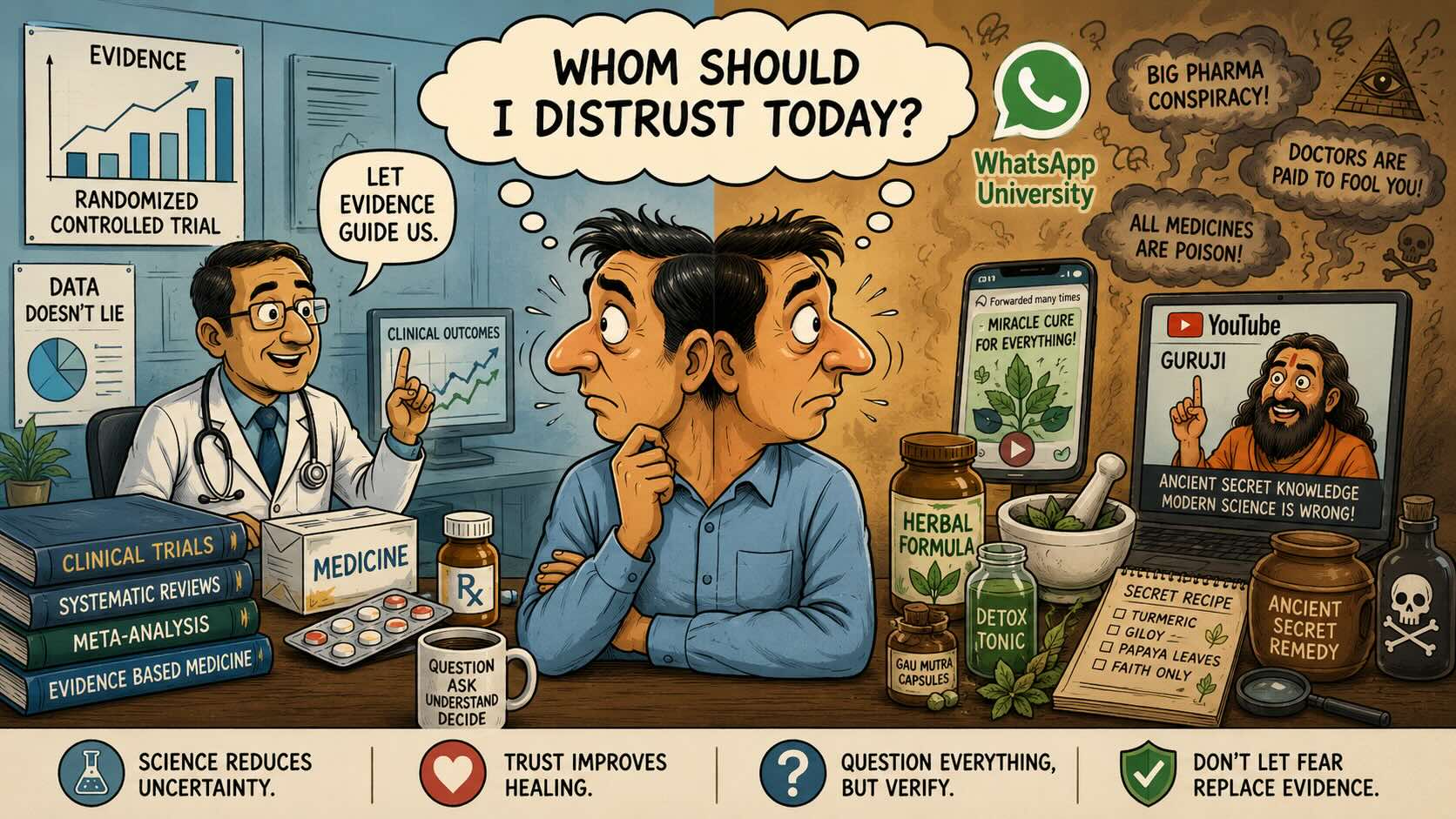
Social media has become the world’s largest nocebo generator. If medieval societies had witches, modern societies have forwarded messages. The modern patient arrives for consultation already pre-inflamed by Google, YouTube, and three family WhatsApp groups. The social reels can be heard blaring at every street-corner tea shop:
“Doctors don’t want you to know this……….”
“Pharma companies hide this cure………….”
“This common medicine silently destroys kidneys……………”
“A famous actor cured cirrhosis with papaya leaves……………”
“One spoon of turmeric reverses all inflammation…………..”
Modern misinformation is, every minute, manufacturing distrust followed by anxiety in every innocent person looking for some entertainment in reels. The patient who reads twenty alarming posts before sleeping will often wake up with symptoms. Not imaginary symptoms—experienced symptoms.
A nocebo effect is not a fake illness. It is real suffering generated through expectation and fear. Researchers studying mass psychogenic illness have shown how fear and expectation can spread symptoms through groups and communities. Today social media acts as a giant amplifier of collective anxiety.
Previously, a worried aunt could frighten only the family. Now she has global reach. Historically, the doctor-patient relationship was shielded by a “sacred canopy” of trust. In our information-dense age, that canopy has been replaced by a “digital umbrella” of conflicting WhatsApp Forwards.
This “selective scepticism” is absolutely fascinating: a patient will question decades of pharmacology but blindly trust a shirtless man on YouTube holding a celery smoothie. Every ‘Samosa-devouring’, ‘Gol-gappa-crunching’, and ‘roadside-chat-eating’ man is worried about side effects of his life-saving antibiotics.
The Feedback Loop
Healers occupy a peculiar moral territory. Society expects them to be scientifically infallible, emotionally available, financially disinterested, endlessly patient, technologically updated, compassionate saints, who are available on WhatsApp even at 2:13 AM.
When outcomes are good, medicine is science. When the disease progresses despite treatment, patients often feel personally betrayed and the healers become immoral. This may be understandable in a sense. Illness creates vulnerability, and vulnerability seeks certainty. But medicine operates in probabilities, not prophecies. Doctors do not operate from a position of omnipotence. They just work to achieve a statistical advantage. The suspicious patient expects certainty from an uncertain universe. This expectation itself breeds disappointment.
So, distrust creates a self-fulfilling prophecy. Distrust leads to reduced adherence to treatment prescribed. Poor adherence worsens the disease. Worsening disease is then used as “proof” that medicine doesn’t work, further increasing distrust.[9]
Doctors Are Not Innocent Either
To be fair, medicine has earned this distrust. Doctors often communicate poorly. Hospitals become impersonal. Corporatisation of medicine has distorted priorities. Not uncommonly, the physicians are rushed, dismissive, arrogant, or financially conflicted.[10]
Research shows that poor communication itself can intensify nocebo responses. Negative wording, rushed explanations, and emotionally cold encounters may worsen symptoms and anxiety.
The trust is not a moral entitlement automatically granted by a medical degree. It is a two way street. It must be earned repeatedly. A physician who behaves mechanically should not be surprised when patients seek humanity elsewhere—even if elsewhere happens to be a man selling detox juices on Instagram.
The challenge for modern medicine is therefore not merely scientific competence but relational maturity. The consultation itself should be a part of the treatment.
The Final Irony
Most suspicious patients deeply believe that stress causes diabetes, anxiety causes hypertension, anger causes heart attacks, loneliness worsens cancer outcomes, and depression weakens immunity. But when told that trust, reassurance, confidence, and therapeutic relationships also influence health, suddenly this sounds “unscientific.”
Psycho-neuro-immunology tells us that emotions often cause disease, and can also assist healing. Human beings are biopsychosocial creatures. Expectations do affect symptoms, and outcomes. This does not replace pharmacology or surgery—but it powerfully interacts with them. A good doctor is neither magician nor mechanic. He is part scientist, part interpreter, part counsellor, part risk manager, and occasionally part emotional shock absorber.
It is tragic that patients are frittering away a valuable source of healing. They also have responsibility towards healing. Trust does not mean blind obedience. Questions are healthy. Second opinions are reasonable. Scientific scepticism is valuable. But perpetual suspicion is not wisdom. At some point, a patient must decide: “If I have chosen this doctor, will I allow the treatment a fair chance to work?”
Swallowing a tablet while simultaneously believing it is poison is biologically confusing behaviour. The body hears both messages. And unfortunately, it often listens to fear more carefully than hope. Healing requires a degree of surrender—a “leap of faith” to break the loop of biological stress.
Bhasmasur* and The Art of Self Sabotage
The modern patient is, in some ways, a digital Bhasmasur. The ancient demon performed severe penance to obtain divine power, only to turn that power recklessly upon the very source from which it came—and eventually upon himself.
Today, the penance is different. It is hours spent on Google searches, medical chat forums, YouTube videos, and artificial intelligence applications. The boon being sought is access to medical knowledge. But information without judgment can become its own curse.
A patient may spend three hours online and suddenly feel equipped to challenge twenty years of clinical experience. Suspicion then quietly replaces curiosity. Anxiety replaces understanding. Every doctor appears corrupt and every prescription begins to look like a conspiracy.
The tragedy is that the patient believes he is attacking the doctor, the hospital, or the pharmaceutical industry. But often, suspicion harms the patient first.
In the original myth, Bhasmasur* destroys himself by placing his own hand upon his head. In modern medicine, fear and distrust can sometimes do something remarkably similar.
Yet the answer is not blind faith. Medicine does not ask patients to stop questioning. It asks only that suspicion does not become stronger than the desire to heal.
The doctor and patient are not adversaries negotiating a conspiracy. They are two anxious human beings standing together against disease.
Medicine works best when evidence and trust stand on the same side. Healing begins when suspicion loosens its grip just enough for hope to enter the room.
Notes:
- *The mythological story of Bhasmasur can be read at https://en.wikipedia.org/wiki/Bhasmasura. Last accessed on 14 May 2025.
- It is given that every doctor is not corrupt, nor every patient suspicious. A good communication between the two is all that is needed to dissolve everything that has been said above. Unfortunately, if communications were good and easy, no wars would be fought.
References
- [i] Häuser W, Hansen E, Enck P. Nocebo phenomena in medicine: their relevance in everyday clinical practice. Dtsch Arztebl Int. 2012 Jun;109(26):459-65. doi: 10.3238/arztebl.2012.0459.
- [2] Enck P, Benedetti F, Schedlowski M. New insights into the placebo and nocebo responses. Neuron. 2008 Jul 31;59(2):195-206. doi: 10.1016/j.neuron.2008.06.030.
- [3] Olshansky B. Placebo and nocebo in cardiovascular health: implications for healthcare, research, and the doctor-patient relationship. J Am Coll Cardiol. 2007 Jan 30;49(4):415-21. doi: 10.1016/j.jacc.2006.09.036.
- [4] Pilcher H. I made my husband ill with a few words – nobody is immune to the power of the nocebo effect. The Guardian. Available at https://www.theguardian.com/commentisfree/2026/may/08/nocebo-effect-science-health?utm_source=chatgpt.com accessed on 14 May 2026
- [5] Philips CA. The Liver Doctor: Stories of Love, Loss and Regeneration. Available at https://harpercollins.co.in/press-release/the-liver-doctor-stories-of-love-loss-and-regeneration-by-dr-cyriac-abby-philips/ accessed on 14 May 2026
- [6] Souvatzi E, et al. Trust in Healthcare, Medical Mistrust, and Health Outcomes in Times of Health Crisis: A Narrative Review. Societies. 2024;14(12):269.
- [7] Benedetti F, Carlino E, Piedimonte A. Increasing uncertainty in CNS clinical trials: the role of placebo, nocebo, and Hawthorne effects. The Lancet Neurology, 2016; 15, 736-747t.
- [8] Hansen E and Zech N (2019) Nocebo Effects and Negative Suggestions in Daily Clinical Practice – Forms, Impact and Approaches to Avoid Them. Front. Pharmacol. 10:77. doi: 10.3389/fphar.2019.00077
- [8] Pilcher H. This Book May Cause Side Effects: Why Our Minds Are Making Us Sick. Published by Atlanta Books. Available at https://books.google.co.in/books/about/This_Book_May_Cause_Side_Effects.html?id=Vimi0QEACAAJ&redir_esc=y accessed on 14 May 2026.
- [10] Anand AC. Speaking for myself ‘Prisoner of War-Sold for six lakhs’. Natl Med J India. 2014 Jan-Feb;27(1):30-4
The essay was wonderful to read. Thoughtful and lucid writing.
This is brilliant AC Sir.
I have experienced many of those things, but to collate them all, and communicate them to us 👌🏻
Thank you.
AC sir makes a very polished poignant case for rectitude on part of patients. My great grand sire who was erudite and comfortable with English as good as Brits, would aver that the word patient makes it incumbent for the one seeking succour from ailment to be patient! Patience is a virtue vastly underrated in our present fast paced world. The most illustrative story of patient lack of trust in medicine, is that of late Steve Jobs. Jobs tried alternative therapies, even outright voodoo before coming to a hospital for his terminal care.
Some comments….
Finally treatment is by so called DOCTOR of any pathy
The major conflict is obligation for FEE.
Who is an ideal doctor who bevomes GOD
Checks immeditly
Diagnosez correctly
No tests suggested
Cure assured
No fee collected.
DOC you are GOD.
Thoughtful and timely. Needs wide circulation
Extremely one sided article with one sided perspective. Measuring all patients with the same yardstick. Needs to introspect and perceive from the other side of the fence. Patients are not gullible fools. I found the article offensive. He needs to get out of the doctor’s chair, forget his ego, listen for once, be receptive to the patient’s point of view.
Rationalisation &/or Denial are usual responses to illness. Unfortunately the barriers in Patient:Doctor communication often continue to persist.
The way out is accurately shown in this article.
A lucid article in a long time that I could connect.
Very insightful information. Gives a different perspective to the currently deteriorating doctor patient relationship.
Sir
Extremely well analysed and threshed out. Treatment is a team work of both patients and their healers. Trust is the foundation on which it is built.
It is always a pleasure to read your articles and posts
Regards
Quite relatable!
Pleasurable and relatable read!!
Like the political world is divided into 2 sides – refusing to converge- the medical world is also divided into 2 sides.
Both sides are partially right and wrong at the same time.
A reckless bus driver can kill the passengers- that does not mean I will start hating all bus drivers not should bus drivers try to defend themselves
We sit in a bus or lay on the OT table – we are essentially handing over our lives to someone else. For no mistake of ours we can be paying a price.
While the article is good – it can improve by focusing more on what needs to be done esp in ChatGPT era
Rightly said!!
Wonderful analysis. I fully agree with the thoughts expressed in the article.
brilliant article Sir, relatable so well in toady’s practice ,best wishes and rgds
Fantastic view Sir. It is so true.
It’s as beautiful as it is true.
A cutting, thought-provoking piece. The most powerful line was that “the body hears both messages” – medicine and fear. In an age of internet access for all, but not necessarily good judgement, this essay captures the strange tragedy of modern healthcare: people demanding certainty from science, while trusting algorithms with absolute faith.
We need to oust the Bhasmasur of reservations in Medical education at all levels. We need to properly compensate the Doctors for the humongous effort in becoming a Doctor. The entrance exams, the medical college then again an entrance exam then postgraduation then again an entrance exam then again a superspecialisation and the need to keep themselves continuously updated. And honestly speaking the society hates seeing Doctors earning decently enough to carry on their families and educate their own children. Many of rich and affluent class who come in flashy luxury cars, have a coffee in cafe coffee day and have a hard time paying a measly consultation fee of a Doctor on the billing counter. The public at large in India believes that they are directly putting money the pockets of doctors foolishly without realising that only a miniscule part of the hospital bill goes in the salary of a Doctor. And forget about poor MBBS doctors in India. They are worse than even Ayurveda’s graduates. They are absolutely nothing even in front of their own families. 99% of genuine doctors in India want to quit practising medicine but they are stuck because they have sabotaged a significant portion of their lives to this profession which has given them almost nothing. And they are not equipped for getting in some other trade. What kind of society we have built? A society where mediocrity and stupidity are celebrated. How else can you justify a person securing minus 40 marks becoming eligible for entry into a specialisation in medicine. And few people who have lamented that they have to offer their body to a surgeon on an operation table don’t say a word about reservation in medical education, privatisation of medical education, rampant corporatisation of healthcare, poorly compensating insurance and govt schemes and justifying in every way the low compensation which Doctors receive and forget about respect. In today’s era even Chat GPT gets more respect. The same society doesn’t mind crores per annum salary of engineers, CEOs, Lawyers getting lakhs per hearing whether the honourable judge appears or not, even taking a hefty fee just to consult if a case can be heard or not in a Court of law. The society doesn’t have that much problem with corruption in our so called democratic system of governance, bureaucracy, law, our courts , our administration, it doesn’t criminalises corruption in other walks of life as it should. But the society in our India has no qualms about painting all doctors with the same brush. Any Society gets the kind of Doctors, hospitals, bureaucrats, leaders, courts, and police it deserves in a Democracy.
It covers all important aspects that go around a patient along with the disease and it’s management. Everyone experiences these issues on a daily basis in some form or the other. Hence we can identify each aspect which has been so well brought out by this thought provoking and problem solving article. It gives great insight into this complex problem and provides valuable solutions. Wonderful write up Sir.
This is a very well written article, from someone whose elquence in writing articles has been an inspiration for many. It is also, as always, well researched. I have one issue with this article – it dwells far too much on the problem and not as much on the solution. The article mentions that most doctors communicate poorly. This being the root cause of the lack of trust between healthcare providers and receivers, this is the area to we need to address – sincerely, urgently, and effectively. Happy to take this reparative discussion further one-on-one or in these columns.
Wonderful write. So apt for today.
What I see through this article is something even more interesting
in fact many observations in it are painfully true
because it still carries the old human hope
that thought can be properly managed,
that trust can be cultivated,
that the mind can intelligently cooperate with healing.
What I understand is
the article correctly observes the chaos,
but still assumes the thinker is in control of thought.
And perhaps that itself is the illusion.
We romanticize “trust” too much.
The patient trusts the doctor because he wants certainty.
The doctor wants trust because medicine functions better when patients comply.
Both are frightened human beings trying to reduce uncertainty through each other.
That is not some sacred spiritual relationship.
It is mutual psychological dependence.
Similarly, modern medicine still assumes:
if people are educated correctly,
they will think correctly.
But human beings are rarely driven by pure intelligence.
They are driven by fear,
conditioning,
survival,
imitation,
self-protection,
past experiences,
social influence,
and insecurity.
The suspicious patient is not logically “choosing” suspicion.
His entire nervous system may already be conditioned toward fear.
Likewise,
the doctor’s desire to be trusted,
admired,
respected,
believed,
seen as competent,
is also deeply psychological.
Both sides are functioning through conditioning.
The article says:
too much Google knowledge without judgment becomes dangerous.
But what I see is:
all second-hand knowledge becomes dangerous the moment it becomes identity.
Whether it is:
scripture,
Google,
medical textbooks,
YouTube experts,
gurus,
AI,
or scientific ideology —
the danger begins when borrowed knowledge becomes psychologically “me.”
Now identities form:
“I am informed.”
“I am anti-pharma.”
“I am natural.”
“I am evidence-based.”
“I am the expert.”
“I am the saviour.”
And once identity enters,
clarity disappears.
Then discussions are no longer about healing.
They become defense of psychological positions.
That is why the Bhasmasur metaphor in the article is actually profound.
Because human thought itself behaves like Bhasmasur.
Thought creates fear.
Then creates systems to escape fear.
Then becomes frightened by its own creations.
Human beings continuously psychologically burn themselves with their own hand.
Not only patients.
Entire civilization functions this way.
One line in the article comes very close to something fundamental:
“The mind is not outside the body commenting on events. It is the event.”
That is extraordinarily important.
Because perhaps fear is not something we “have.”
Perhaps the structure itself is fear.
The observer and the fear may not actually be separate.
The article finally says:
trust and evidence must stand together.
But what I see is:
human beings endlessly replace one illusion with another.
Yesterday:
blind faith in doctors.
Today:
blind faith in influencers.
Tomorrow:
blind faith in AI.
The object changes.
The psychological movement remains the same.
The patient wants certainty.
The doctor wants certainty.
Science wants certainty.
Religion wants certainty.
But life offers none.
Medicine is not prophecy.
It is statistical probability trying to reduce suffering in an uncertain biological system moving toward decay and death.
Perhaps the article correctly sees that fear poisons the body.
But it still carries hope that fear can be intelligently managed through better understanding.
And maybe human beings continuously create fear precisely because the entire psychological structure is trying to become permanently secure in an insecure world.
So finally,
what I understand is this:
The suspicious patient and the reassuring doctor are not opposites.
They are two expressions of the same frightened movement.
Dear Anil, i loved reading this beautiful, so well written article. What you say is absolutely correct and corroborates what i try my best to instil in doctor colleagues of mine (those who are willing to listen!), to listen well, be empathetic and instil trust.
If i may suggest, please do read a book called ‘Cured” written by Dr Jeffrey Rediger ,MD. who has delved very deeply into ‘spontaneous’ healing.